How To Target The Baby Boomers

What is a baby boomer?
Baby boomers are the generation born between 1946 and 1964 during the baby boom after the 2nd world war, hence the name ‘baby boomers’.

They didn’t grow up with the standard of technology that we deem normal today, so baby boomers are having to learn how and why to use the Internet all by themselves, unless of course, they have help from their grandchildren who tend to find the lack of knowledge regarding technology amusing.
It would seem that Baby Boomers are not as anti-tech as some might assume. While it is true that they sure do use the Internet differently to us, they are active online and taking advantage of the way the internet can make life easier. As shown in the graph below, this includes checking the weather online, reading the news, and sending emails. They seem to not be as heavy users of social media and the digital marketing aspect. That is left to the younger generations, who’s lives have totally evolved around technology. From attending job interviews via webcam, to online shopping and watching TV through streaming online, there is definitely a clear shift in how life was conducted from when our grandparents were growing up.
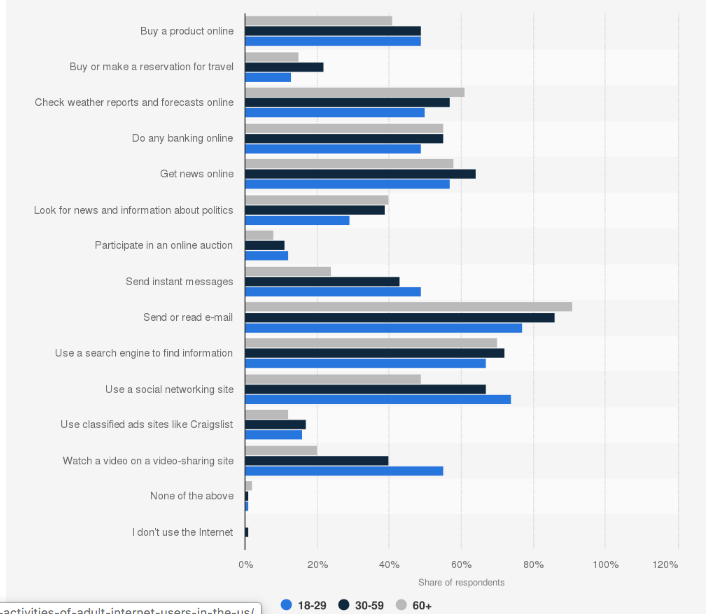
Most popular daily online activities of adult internet users as of February 2017

The best ways to target these Baby Boomers:

When aiming marketing strategies towards those not-so-savy Facebook users, a different approach compared to targeting teens and young adults is required.

  1. Be clear and concise- Firstly, make it clear as to what you are actually offering. As Baby Boomers are likely not expecting to come across an incentive to purchase online, it is best to be clear and concise to avoid confusion or dismissal of your message. To achieve this, avoid using slang terms or abbreviations, what may seem obvious to a daily Facebook user may not be so obvious to someone who hasn’t spent much time in the online space. Being straight forward will ensure that your marketing efforts are not going to waste and increases the chance that you will capture the attention of your target market.

2. Provide useful information- In order to capture and retain the attention of your target market, you need to provide value and a reason for them to continue using the online space. Statistics show that baby boomers use the internet to find and learn information, as a marketer you can use this to your advantage. Explain what your product does and how it will improve their lives- explain why they need it.

3. Make your website device friendly- Whatever link you’re providing on an advertisement, it needs to be accessible on a PC, mobile and iPad, otherwise the user is just going to get confused and click off. This is an affective way to ensure your audience loses interest. However, a modified version for each device to make viewing and scrolling easier makes a huge difference in retaining the audiences interest and attention, without having to struggle to find links and avoiding the continuous need to zoom in to read and zoom out to view the contents of the page.
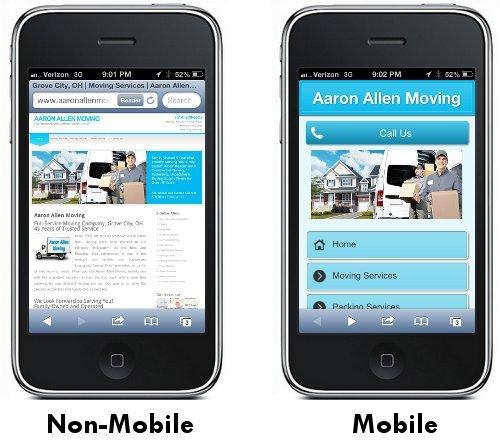
A clear difference between a mobile friendly and non-mobile friendly website

Following these tactics is a good way to structure your strategies initially, however, each individual is different so market research is required to determine what will work best for your specific audience.

Good luck!
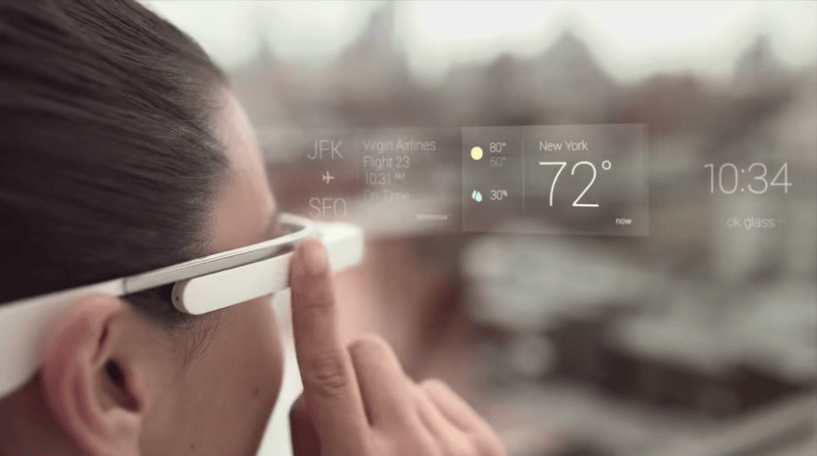
Google Glass or Google Pass?

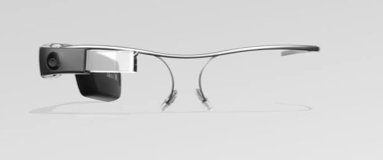
Google Glass is Googles attempt at creating smart glasses. Google Glass are worn on the head, as you would a normal pair of glasses, which feature a small laser light that creates the display that you would see in front of your eyes. Glass can display the time, weather, message notifications, photos, videos and more. Similar to what you can access of an iPhone. On the side of Glass there is a touchpad which can be used to scroll through the menu to select an app, or you can use voice commands.

Image result for google glass
Source: Forbes.com

While smart glasses themselves aren’t exactly dominating the market, Google certainly did not do themselves any favours when it came to creating the product.

The hype behind the product before it was actually released was substantial, but when the glasses came to market, it was disappointing, and essentially, a huge flop. Google Glass are now known as ‘that innovative product that failed’.

Upon release, Glass was available exclusively to a selected few customers, for $1500. This selection of ‘early adopters’ consisted mainly of tech geeks and journalists, who would find little use for the product. One user described Google Glass as the ‘worst $1500 I ever spent’.

Firstly, Google struggled to distinguish the problem that the Google Glass would solve for customers. Neither of its two main functions; to take a photo or video quicker than it would take to grab your phone out of your pocket, and to instantly search the web using voice commands, seemed to fill a gap in consumers lives. We have our smart phones for that.

Source: Google Glass

Oh, and it didn’t even seem to conduct these two functions correctly, with reports stating that the glasses would stop working during firewall updates, and the main menu and apps sometimes being unresponsive.

People were also concerned about constant radiation being emitted so close to their heads, which caused headaches, as well as concern involving the built in camera. Due to this, the glasses were banned from casinos and movie theatres to prevent illegal filming. Too many ways for the Glasses to be exploited, as well as Google failing to make it clear as to whether the Glasses were intended to be worn all the time, or only on certain occasions.

Source: CNN.com

Above all, the glass were unattractive, and frankly, strange looking as you can see from the image above. I mean, would you wear these?… In public? And would you talk about loud to give commands? Google seemed to assume that the hype behind Google Glass would eliminate the fact that people may be embarrassed to wear these in public.

Now we can’t discard the fact that smart glasses are most definitely a thing of the future that will eventually become as normal as a smart phone is now, but I think the truth is, that we are simply not ready yet.

You Are Being Targeted

An article on trigger marketing and how you are being targeted.

Trigger marketing is essentially an event based marketing strategy that occurs due to a certain activity. It is more than likely that you’ve actually been the target trigger marketing yourself.

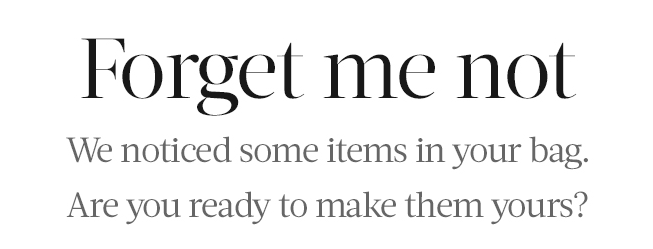
You know when you’re, minding your own business, doing some online shopping for a few new cat toys for your beloved fur babies (you know you spend too much money on them but it is what it is) and then you think, ‘wait, I could probably find this cheaper on eBay’? So you go on eBay, have a browse and find that yes, this lead for my cat is $2 on eBay (click here if you’re interested) as opposed to $20 at Petbarn. Forgetting about your cart on Petbarn, already filled with 22 items of unneeded but oh so wanted cat items, you move on to eBay to continue your shopping for a quarter of the price. Petbarn is more than likely to send you an email or give you a notification to say ‘Hey! Don’t forget about us! You haven’t wasted your money on us yet!’, but like, not exactly in those words. That’s trigger marketing.

An email from Mecca Maxima as I left items in my cart without purchasing

Trigger marketing aims to create a trigger in your mind to recall a brand name to influence your purchase.

Online websites seem to be big believers in this strategy, and from my possibly too personal anecdote above, they probably have good reason too. In cases where a brand main competitor is not eBay, for example a make-up brand, as consumers we may check other sites for the same products at a cheaper price, but they are often very similar in price, or too cheap to not be dodgy, in this instance trigger marketing would be an effective strategy to remind the consumer to purchase.

This can be equally as useful for the consumer if they actually have forgotten that they were in the middle of an online shopping spree and need to be reminded to check out.

Some forms of trigger marketing however, are not so helpful but instead just plain pushy and on the verge of being deceitful. I shall mention another anecdote that I’m sure you are just dying to read.

Buying an outfit online through Fashion Nova, I notice a banner ad on the top of the screen to let me know that a promotion code that I could use to get 10% off my order is going to expire in 10 minutes. Frantically, I scroll through what items I want to buy, select the right size and colour, making crucial decisions as to what I want in my cart, and hurry to enter the promo code and process the purchase by entering my card details. Fortunately, I have manage to make my purchase within the 10 minutes and gotten 10% off. Awesome. The timer has finished. Except, what is that I see? Oh, the timer has just automatically reset.

Source: https://www.fashionnova.com/

Silently laughing to myself, I realise that I have fallen for their marketing tactic. I mean, I was always going to make the purchase, but I could’ve done it with less anxiety about the possibility of not receiving that 10% discount.

Turns out, I didn’t even love the clothes when they arrived, and I’ve worn them about twice, but every time I look at that pair of trousers, I remember that evil timer that I fell victim too.

Another example of trigger marketing, based on the event of me simple browsing the website.

While this experience didn’t exactly put Fashion Nova in my good books, I definitely remember making that purchase vividly and am glad for it as now, as a marketing student I have the benefit of learning about these sneaky tactics and will hopefully not fall for it again.

But we’ll see.

Why Twitter is dying

… And Facebook and Instagram are thriving.

Well, not quite thriving. All the main social media sites have experienced a usage decline in 2019 (Facebook, Instagram, Snapchat), but Twitters popularity has been declining steadily over the last 6 years, and its not stopping any time soon.

According to Buffer.com, Facebook has 2.23 billion monthly active users, a huge difference compared with Twitters meek 335 million.

Although all the main social media sites have experienced a usage decline in 2019 (Facebook, Instagram, Snapchat), Twitters popularity has declined steadily within the last 6 years, and its not stopping any time soon.

Twitter will no longer be announcing its monthly user count, to avoid being compared other social media sites, which record their usage through this metric. Twitter blames this downfall on the fact that they have recently deleted a number of bots/spam accounts, which has affected its usage numbers. Instead, Twitter has opted to only share its daily usage count, as they believe that measuring by the number of people who use the site daily is a better indication of its popularity. Coincidentally, this metric presents the site in a slightly more optimistic view, as Twitter now (2019) has 126 million daily users (Facebook has 1.23 billion daily users), an improvement from last years 115 million, as opposed to its decrease in monthly users- 326 million to 321 million.

What I’m interested in, is whether Twitters deletion of spam accounts really is the crux of why its numbers have declined.

I’m inclined to think this is not true. I don’t use Twitter myself, nor am I aware of any of my friends using it, which is partly why I have no interest in using it myself. Unless my intention with using social media is to connect with celebrities, I have no idea what I’d even do on Twitter or who I’d follow or who I’d tweet too. In fact, I probably wouldn’t tweet at all. Instead, I feel much more comfortable posting a single photo on Instagram or scrolling through my Facebook feed.

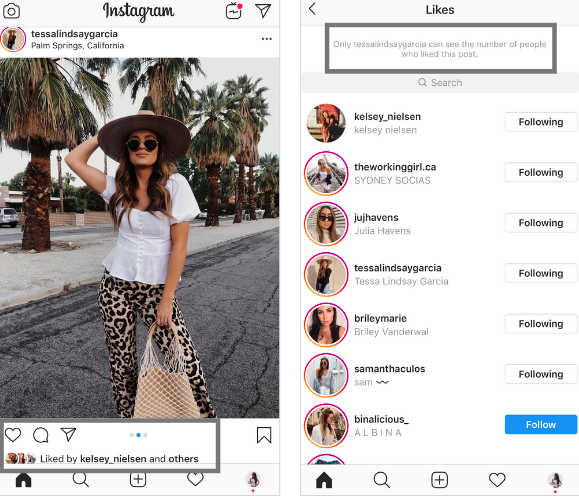
I think a lot of millennials would agree with me in the fact that, we’d rather speak with photos, than with 140 characters and no more. Twitter’s decline in post volume records support this, which is a huge threat to its entire existence.

After all, without tweets, Twitter is nothing.

Introducing myself

Kiara’s Digital Marketing Blog

By Kiara Bingham

“Social media is not a media. The key is to listen, engage, and build relationships.”

David Alston

Hello! Thanks for visiting my blog, or stumbling across it!

My name is Kiara, I’m a 21 year old, 2nd year marketing student at RMIT university in Melbourne.

This blog is my outlet to discuss issues regarding social media and digital marketing in general.

I hope you enjoy reading as much as I enjoy writing and discussing these topics with my readers. If something strikes you as interesting or intriguing, I’d love it if you left a comment so I can hear your thoughts. I always reply back.